

Paris off the beaten track
When you have to visit Paris, you don’t always know where to start, do you? And we often have certain images in mind: the arts, love, gastronomy…
But what if you explored unusual places in Paris that offer a fresh and unique perspective on the City of Light? This is what I propose to you by revealing some of the extraordinary and original places of Paris to make you discover the city of light in a different way.
The Seine with stops
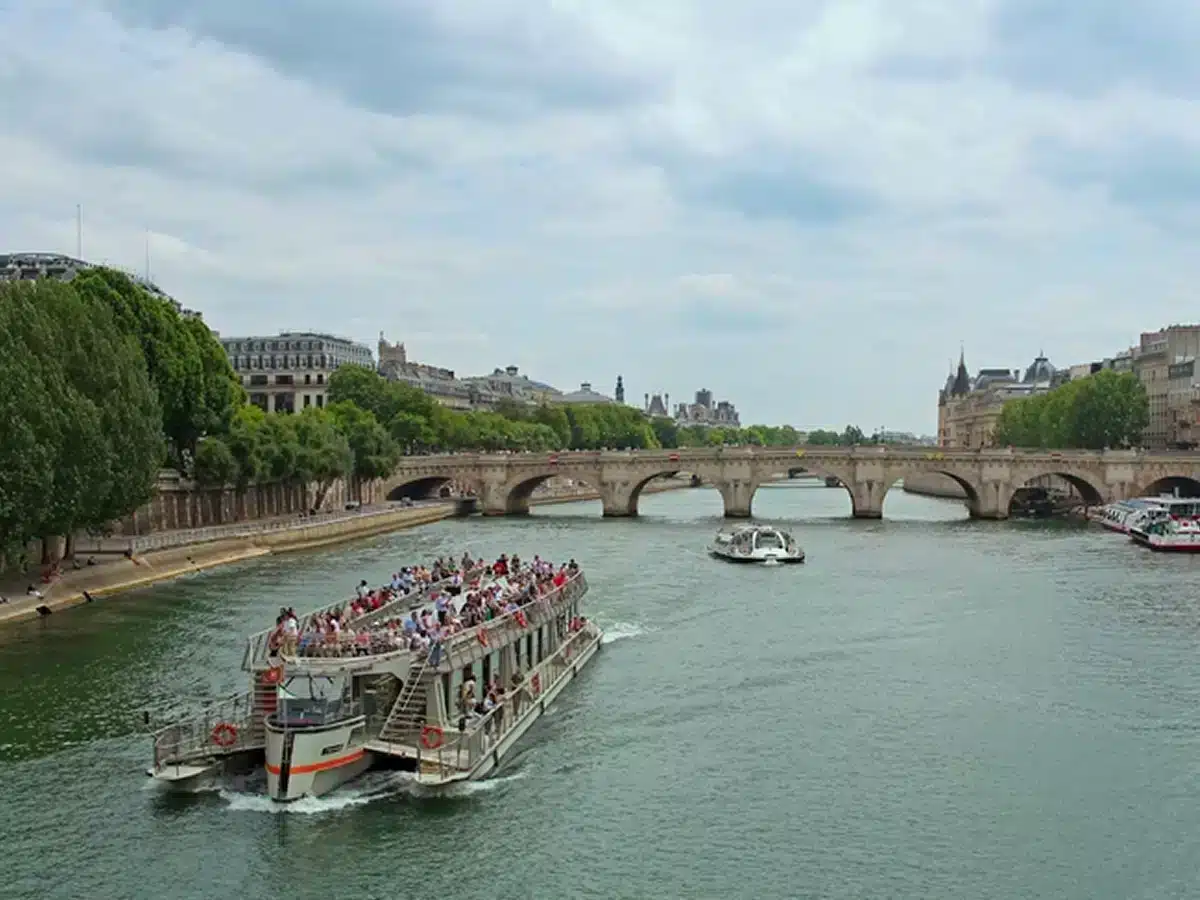
What better way to discover Paris than to be on the water in the heart of the capital, to discover its treasures: embark on a boat-bus for a cruise on the Seine, which will allow you to discover the city of light at your own pace.
With the clever system offered by these shuttles, to get off and on as many times as you like, you can discover some of the most magnificent places in Paris while sailing on the water: the Alexandre III Bridge, also called the Lovers’ Bridge, the Place de la Concorde, the Invalides, the Town Hall, but also the Louvre, the Eiffel Tower and of course Notre-Dame, while being rocked by the Seine. A good plan to discover the heart of Paris without effort.
There are 9 stops in all that are served every 20 minutes, so it’s perfect to target the places that interest you or let you navigate without stopping to look around. In short, it’s a great way to find your way around Paris and its monuments without stress!
Streets and squares
Of course, there’s Montmartre Square and its adjacent streets, but there are many other hidden gems to discover that are also less crowded! For a unique experience with the help of a Paris tourist guide, explore a neighborhood that feels like a real village: head to the Butte aux Cailles. Its cobbled streets are surrounded by charming brasseries and cafés, with houses featuring varied facades. Stroll down rue Alphand, Passage Barrault, and Passage Sigaud, and let yourself get lost in these picturesque streets, each more charming than the last!
Departure from Corvisart metro station (line 6, then about 500 m walk)
If you like street art, you should know that Paris has a whole district dedicated to this modern art in streets that are not far from the Butte aux Cailles. If you go to the 13th arrondissement, on the Boulevard Vincent Auriol, where there are nearly 25 works of art, you won’t know which way to turn because there are so many giant or more intimate frescos: Cryptik, Seth, Shepard Fairey…. The Street Art artists will not leave you indifferent!
Departure : Metro station Nationale (line 6)
- Meet at 141 to 171 Boulevard Vincent Auriol
- Go back up to Place Pinel.
And above all, keep your eyes open all around you so as not to miss any fresco, even the smallest one!
As we know, the squares have their own charm and are very numerous in Paris. So, in order not to miss some of the most typical squares, here are the ones I suggest:
- Place de la Victoire, one of the royal squares, very elegant as it is lined with private buildings, each more beautiful than the next – Metro: Bourse or Sentier (line 3)
- The Place Marcel Aymé in the 18th district, named after the writer and which pays homage to his hero Passe-Muraille – metro Station Abbesses (line 12)
- The Place de Furstenberg in the heart of the Saint Germain des Prés district. In fact, it is the rue de Furstenberg which has in its central part a very romantic square close to the Museum and the former studio of the painter Delacroix. Rue de Furstemberg – Paris 6 (metro – Access 3 rue Jacob / 4 rue de l’Abbaye – metro station St Germain des Prés (line 4) or Mabillon (line 10)
The covered passages
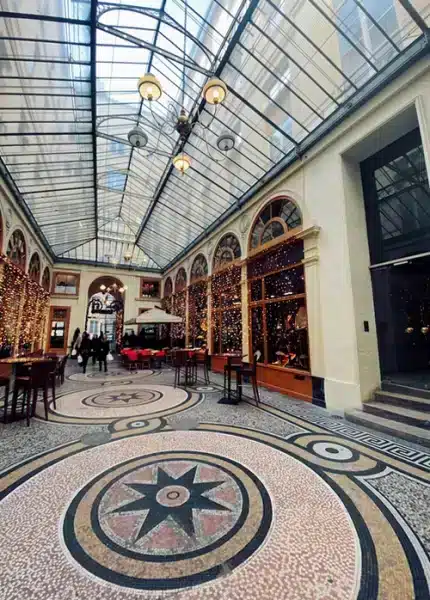
They have names that make you dream: Passage des Princes, Passage des panoramas, Galerie Colbert, Galerie du Grand-Cerf….But what do we really mean by the term covered passage?
In fact, it refers to covered galleries that are often commercial and that link the streets of Paris to theatres, museums, shops, restaurants and tea rooms…. Protected and often glazed, they compete with elegance and unusualness and invite you to find finds but also to stroll around. They often have themes linked to their history and to the buildings that surround them, but also to the skills of the craftsmen and artists they host.
To discover some of the most elegant and certainly some of the most original, visit :
In the Faubourg Montmartre district (metro Richelieu-Drouot line 8 and 9):
- Passage des Panoramas, the first open covered passageway – 11 boulevard Montmartre – Paris 2 nd arrondissement
- Passage Verdeau and its antique dealers – 6 rue de la Grange-Batelière – 75003 Paris 3rd district
In the Strasbourg Saint-Denis district (Metro Strasbourg Saint-Denis Line 9)
- Passage Brady also known as Little India – 46 rue du Faubourg Saint-Denis – Paris 10th arrondissement
In the Sentier district (Metro Sentier – line 3)
- Passage du Caire, the oldest covered passage – 2 place du Caire – Paris 2nd arrondissement
In the Palais-Royal district (metro station Palais-Royal – line 1):
- Galerie Vivienne and its beautiful mosaics on the floor – 4 rue des Petits-Champs – Paris 2nd arrondissement
- Galerie Véro-Dodat and its elegant boutiques – 19 rue Jean-Jacques Rousseau – Paris 1st arrondissement
So enjoy your stay and don’t hesitate to share your good tips!